

A student’s future is rarely destroyed in one dramatic moment. It is usually shaped by small choices repeated every day: the phone picked up before homework, the lesson ignored after class, the assignment delayed until midnight, the excuse made once and then repeated until it becomes normal. James Clear’s Atomic Habits gives students a simple but serious lesson: your life changes when your daily system changes.
The mistake many students make is that they wait for motivation. They wait to feel focused, inspired, confident, or ready. That feeling may come for one day, but it will leave the next. A serious student learns to build habits that work even when motivation is weak. The goal is to become the kind of person who studies with discipline, keeps promises, manages time, and improves quietly until the results become visible.
Here are five things every student must do.
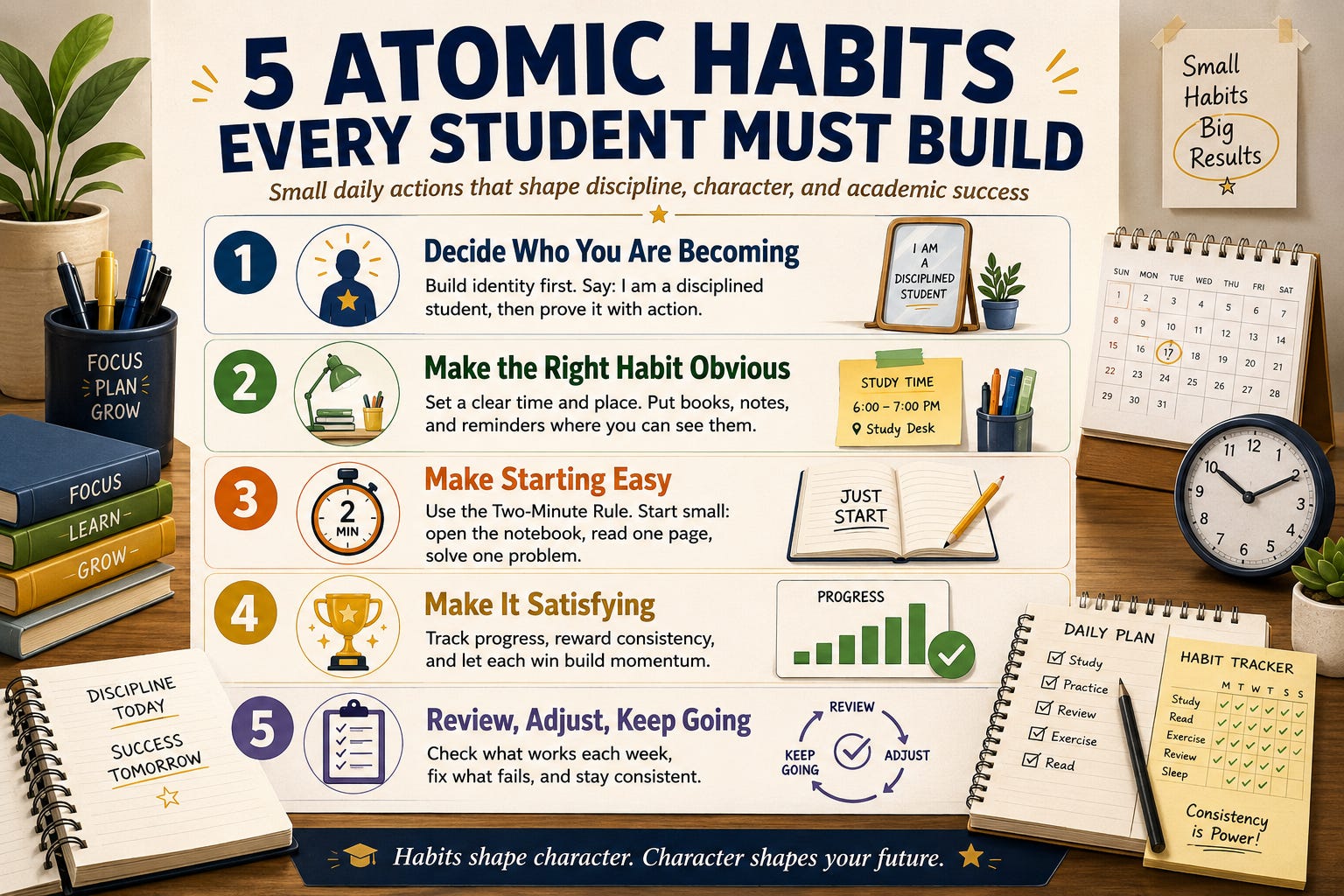
1. Decide who you are becoming
Before asking, “What grade do I want?” ask a better question: “What kind of student am I becoming?” This matters because habits become stronger when they are tied to identity. A student who says, “I want good marks,” may study for a few days before an exam. A student who says, “I am the kind of person who prepares every day,” begins to act from a deeper place.
Write one clear identity sentence and keep it where you can see it. “I am a disciplined student.” “I am a reader.” “I am someone who finishes what I start.” “I am someone who tells the truth even when it costs me.” Then prove that identity through one small action today. Every page read is a vote for becoming a reader. Every assignment finished on time is a vote for becoming responsible. Every honest answer is a vote for becoming trustworthy.
Character grows when actions repeat. You do not become disciplined by thinking about discipline. You become disciplined when you show up on the days you would rather quit.
2. Make the right habit obvious
Students often fail because the good habit is hidden and the distraction is sitting in front of them. The book’s first law is simple: make it obvious. If you want to study, your books should be open before study time begins. If you want to read, the book should be on your desk. If you want to pray, journal, review notes, or complete homework, the reminder should be visible.
Use a simple sentence: “I will do [habit] at [time] in [place].” For example, “I will review my science notes at 7:30 p.m. at my desk.” This removes confusion. A vague plan gives your brain room to escape. A specific plan gives your brain a clear instruction.
Habit stacking also helps. Connect a new habit to something you already do. “After dinner, I will study for twenty minutes.” “After I return from school, I will place my phone outside my room.” “After class ends, I will write three things I learned.” When the old habit happens, it becomes the trigger for the new one.
Your environment teaches you silently. Make sure it is teaching you the right lesson.
3. Make studying easy enough to start
Most students lose because starting feels heavy. That is why the Two-Minute Rule matters. Begin with a version of the habit that takes only two minutes. Open the notebook. Write one sentence. Read one paragraph. Solve one problem. Put your uniform out for tomorrow. Clean your study table.
This sounds small, but small is the point. A habit must enter your life before it can grow. Once you start, you often continue. Even when you stop after two minutes, you have still protected the identity of a student who shows up.
Make the habit easier by removing friction. Keep your pens, books, calculator, and charger in one place. Turn off unnecessary notifications. Keep your school bag ready before sleeping. Sit in the same study spot each day. The fewer decisions you must make, the easier it becomes to act.
A good student does not rely on heroic effort every night. A good student builds a system that makes the right action easier than the wrong one.
4. Make good habits satisfying
The brain repeats what feels rewarding. This is why students should make progress visible. Use a habit tracker. Mark a calendar every day you study, read, exercise, pray, complete homework, or revise. The mark gives your brain proof that you are moving. It also makes you want to keep the chain alive.
Rewards should be simple and healthy. After finishing thirty minutes of focused study, take a short walk, listen to one song, eat a snack, or spend ten minutes doing something you enjoy. The reward should come after the habit, not before it. That order matters.
Accountability also makes habits satisfying. Tell a teacher, parent, friend, or classmate what habit you are building. Ask them to check on you. A student who is watched with care often becomes more consistent. This is not about fear. It is about support.
Progress becomes powerful when you can see it. A student who sees effort stacking up begins to believe, “I can trust myself.”
5. Review, adjust, and keep going
A habit can become automatic, but automatic behavior still needs review. Every week, ask three questions: What worked? What failed? What should I change? This keeps you honest. It also stops small mistakes from becoming permanent patterns.
Maybe your study time is too late and you are tired. Move it earlier. Maybe your phone is too close. Put it in another room. Maybe your goal is too big. Make it smaller. Maybe you keep missing a habit because no one reminds you. Add an accountability partner.
Students need consistency, but they also need adjustment. The best system is the one you can keep improving. You are allowed to change the plan as long as you do not abandon the mission.
Atomic habits are small, but their results are serious. A student who improves by a little each day becomes stronger in ways that are hard to notice at first and impossible to ignore later. The student who reads one page today can become the person who finishes books. The student who reviews one lesson today can become the person who enters exams without panic. The student who tells the truth once can become the person others trust.
Your future is already being built. The question is whether your daily habits are building the person you want to become.
Jugnuu is building skill, confidence, and opportunity where it matters most. Support the work. Visit a campus. Help more young Pakistanis gain the training that can change a life.