

A society does not fall apart because it runs out of ideas. It falls apart when it can no longer turn ideas into skill, skill into work, and work into continuity. That is the part modern culture keeps forgetting. We speak about education as if information alone can build a future. It cannot. Civilizations were built by people who knew how to teach others to do real things well.
For most of history, that teaching happened through apprenticeship. This was one of the main ways practical knowledge moved from one generation to the next. Apprenticeship can be best described as the mechanism through which practical skills were transferred across generations and argues that it mattered for human capital, innovation, and growth. That is a much bigger role than modern people usually give it.
The reason apprenticeship mattered so much is simple. A large part of useful knowledge cannot be fully written down. The papers call this tacit knowledge. It includes skill that lives in judgment, timing, observation, repetition, and correction. A person can read about design, editing, carpentry, metalwork, or sales for hours and still fail when it is time to perform. Much of what apprentices learned could not be obtained from textbooks or encyclopedias and was not taught in schools. It had to be learned through direct contact with someone who already knew the work.
That is why the old apprenticeship model began with proximity, not abstraction. A learner stood near a master, watched closely, copied badly, got corrected, and tried again. One scholar described apprentices as learning by “stealing with their eyes.” They learned through observation, imitation, and experimentation. At first they handled small tasks. They cleaned, carried, delivered, and watched. Later they were trusted with harder work, better tools, expensive materials, and real customers. That structure was not glamorous, but it was effective. It turned knowledge into competence.
This pattern goes back much further than medieval Europe. In ancient Egypt, education and apprenticeship were tied to the training of scribes and specialist craftsmen. Schooling was narrow and profession-oriented, while apprenticeship was used for advanced and specialized training, including craft learning. Even the language reveals the intimacy of the process. The Egyptian term for apprenticeship meant being “under the arm” or “under the control” of a master. That is a far more honest description of real learning than most modern policy language. Skill required closeness, submission to correction, and sustained contact with someone more capable.
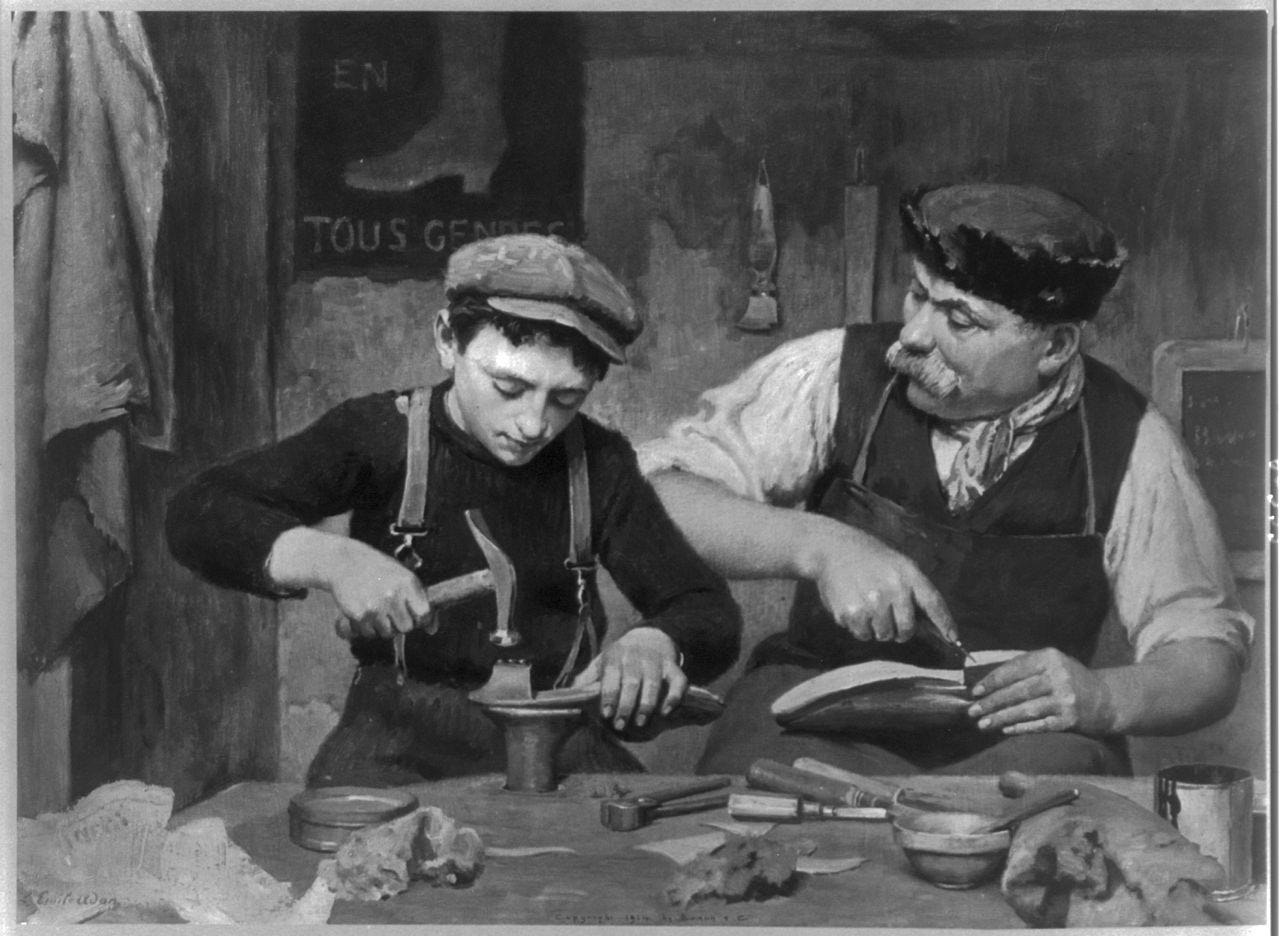
Ancient Egypt also shows that formal schooling was never the whole story. Much of the working population probably learned in domestic and family settings rather than at school. That means civilization depended not only on official institutions, but on stable chains of practical teaching inside homes, workshops, and trades. In plain language, societies worked because people knew how to train the next person.
The human side of this still matters now. In research on young people in depressed parts of North West England, Lorna Unwin found that they judged a worthwhile job by two standards. First, whether an employer would take them under his or her wing and teach them what they needed to know. Second, whether the job would lead to a qualification any employer would recognize. One 17-year-old in construction said that under apprenticeship, an employer would look at a young person and think he could make something of him. That line matters because it reveals what young people are still looking for: not vague opportunity, but formation. They want somebody to teach them, test them, and help them become capable.
In another scenario, a training executive said apprenticeship should have been promoted like a gold standard, because people remembered the status that came from earning recognized papers. They did not remember policy language. They remembered proof. This is one of the major strengths of skill-based learning when it is done well. It does not only transfer knowledge. It gives a young person a visible sign that they can now do something others respect.
If apprenticeship was so powerful, why did respect for learning by doing weaken?
Part of the answer is prestige. Modern societies split the hand from the mind and then ranked them. Abstract learning gained status. Practical competence lost it. The people who could speak in theories began to outrank the people who could make, fix, operate, train, and deliver. But history makes that hierarchy look foolish. Many now admit that apprenticeship played a major role in human capital formation and in the quality of labor. In Britain, the flexibility and strength of training institutions helped explain higher worker skill levels and stronger industrial performance.
Another part of the answer is bureaucracy. It is easier to count hours spent in class than to measure judgment. Easier to certify attendance than to prove mastery. Easier to scale lectures than to build serious mentor relationships. So modern systems drifted toward what is easy to administer, not what is hardest to produce. The result is familiar everywhere: people leave institutions with information, but without the confidence or discipline that comes from real practice.
There is also a deeper cultural mistake here. We began to confuse education with exposure. If someone had heard the language of a field, we started to assume they understood it. But useful knowledge does not work that way. A person does not become a good designer because they watched a few tutorials. A person does not become a sharp editor because they know the names of the tools. A person does not become valuable in the market because they sat through instruction. They become valuable when they can do the work under pressure, with standards.
That is why apprenticeship mattered economically, not just morally. It produced more than trained individuals. It created a way for societies to reproduce competence at scale. This mattered for innovation as well. Many of the important inventors of the Industrial Revolution were trained craftsmen. That point should not be missed. Innovation did not come only from theory. It often came from people who knew tools, materials, and process from the inside. They had lived with the work long enough to improve it.
None of this means theory is useless. The strongest version of the argument says the opposite. Progress accelerated when practical skill and deeper knowledge began to reinforce each other. The hand and the mind work best together. But modern systems often made the wrong choice. Instead of joining abstract knowledge to lived skill, they quietly demoted skill and treated it as second class. That was a civilizational error.
This is where Jugnuu matters.
Jugnuu is not just helping young people learn software. It is rebuilding a chain of transmission that healthy societies have always needed. When a young person learns graphic design, video editing, communication, or AI-assisted workflow through guided practice, repetition, correction, and real output, that is not a lesser form of education. It is one of the oldest and most reliable forms of education human beings have ever used.
That point should be stated clearly because modern language often weakens it. Skill-based learning is not charity in the soft sense. It is not a backup plan for those who “couldn’t make it” elsewhere. It is a serious answer to a serious problem. A society cannot grow if large numbers of young people lack usable competence. A society cannot remain stable if it teaches aspiration but not capability. A society cannot claim to care about dignity while denying people the means to become economically real.
This is why learning by doing deserves respect again. Not because it is nostalgic. Not because the past was perfect. But because the old truth still holds. People become capable through practice, correction, and responsibility. They become valuable when someone trains them to do something well enough that others depend on it. Civilizations rise when they know how to make that process normal.
When they forget, decline begins quietly.
Jugnuu stands on the right side of that question. It treats practical skill as something worthy of seriousness, dignity, and investment. It understands that the future will not be secured by information alone. It will be secured by young people who can actually do things.
And that has always been how civilizations were built.
Together, we can transform lives through education. Your support makes a difference.