


A poor student does not need a certificate that sits in a folder. He needs a skill that can be shown, tested, improved, and paid for.
That is the real argument behind skills development. Training changes lives when it connects a young person to work. It fails when it gives hope without a route into income. This distinction matters for Jugnuu because its work sits exactly where formal education often runs out of power. Young people in underserved communities who need digital confidence, communication, practical assignments, and a credible path toward paid work.
Arvil V. Adams research1 on skills development and social disadvantage states that skills do not come only from formal schools, they come from apprenticeships, employers, workshops, training centers, non-profits, and learning on the job. Ghana proves the point. Less than one percent of its secondary students were enrolled in formal technical and vocational education, yet 80 to 90 percent of basic skills training came through traditional apprenticeships. Kenya reported only 2 percent of secondary students in technical and vocational education, while many young people still learned through informal routes. A country that measures only schools misses the places where poor people often learn first.
This gives Jugnuu a clear lesson. A skills program should not be judged only by enrolment. The better question is what the student can do at the end. Can the student open a laptop, create an email account, write a document, design a poster, edit a short video, build a presentation, speak about their work, and apply for a small paid task?
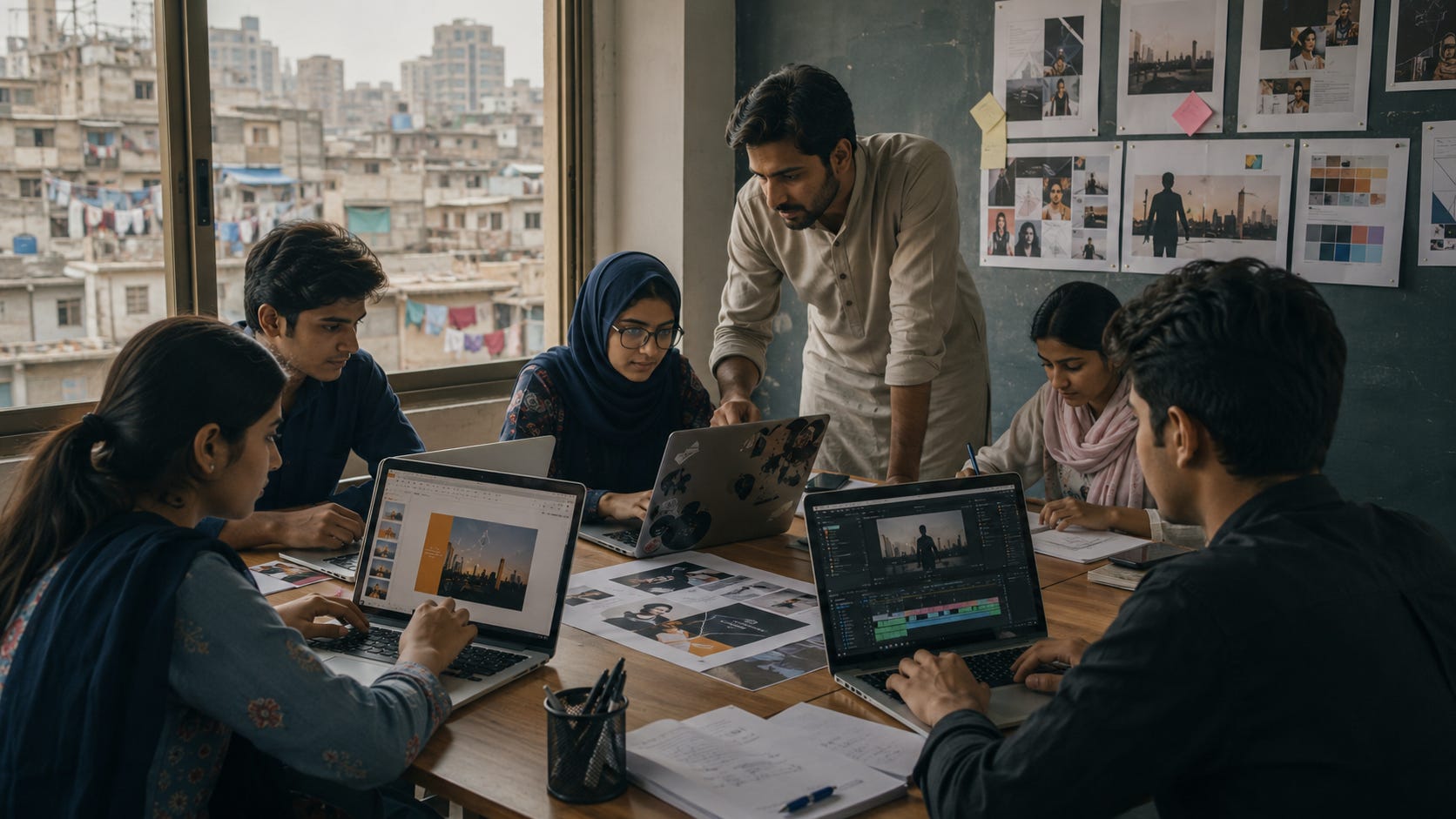
Jugnuu already focuses on that kind of practical learning through digital literacy, communication, financial awareness, project-based assignments, and job or internship support. That puts the model closer to the evidence than many classroom-heavy training programs.
Adams’ strongest warning is that training alone does not solve unemployment. A student can complete a course and still remain stuck if the course has no connection to employers, customers, or real tasks. Vocational education works best when it teaches skills linked to market demand. In China, rapid economic growth created demand for skills, and secondary vocational education produced strong returns for lower-income groups. In Egypt’s Mubarak Kohl Initiative Dual System, students spent two days a week in school and four days in factories. Employers helped design the curriculum, set standards, train students, and assess performance. A 2009 tracer study found that 85 percent of completers were offered full-time jobs by their employers.
That is the standard Jugnuu should study closely. Jugnuu does not need factories to copy the logic. It needs employer-style assignments. A video editing student should not only learn tools. He should leave with edited reels, captions, pacing samples, and revisions based on feedback. A design student should leave with posters, banners, logos, social media graphics, and client-style briefs. A presentation student should leave with actual decks, recorded delivery, and critique. The proof of training should be visible work.
Mexico’s CONALEP gives another useful lesson. The program served low-income upper-secondary students and became stronger after reforms in the 1990s. It reduced the number of professions from 146 to 29 and introduced a modular, competency-based model. Graduates earned 22 percent more than a comparison group and were more likely to find work connected to their training. The reasons matter: local industry ties, instructors with industry experience, autonomy, and a tighter program structure.
For Jugnuu, this means fewer weak courses and stronger tracks. The goal should be to build clear skill pathways that lead to beginner-level work. A four-month program can do this if each month has a measurable output: basic digital confidence, guided practice, portfolio projects, external review, and placement support.
Jugnuu’s current one-year tracking model fits this evidence well, but it should become even more outcome-driven: who completed, who built a portfolio, who got interviewed, who earned money, who returned as a mentor, and who stayed active after three months.
Adams also shows why poor students need more than instruction. Latin America’s Joven programs combined training with work experience, life skills, transportation, health care, materials, clothing, and sometimes childcare for young women. The employment gains were real: women aged 21 and older saw a 10 percent increase in Argentina, 21 percent in Chile, and 7.5 percent in Peru compared with control groups. This matters for Jugnuu because barriers in Karachi are practical. Students need safe classrooms, laptops, stable internet, electricity, cooling, teachers who can give feedback, and families who understand why the training matters.
That is why Jugnuu’s classroom conditions are part of the skills model, not a side issue. A room without ventilation weakens focus. A class without laptops limits practice. A program without steady power loses hours. A student without a quiet place to practice needs more structured time inside the classroom. The research supports what Jugnuu already sees on the ground: social disadvantage is not only about low income. It is also about missing infrastructure, missing networks, and missing professional spaces.
Adams also warns against light vocational exposure. In older secondary programs, vocational subjects often took only one-tenth to one-fifth of the timetable, and studies in Tanzania, Colombia, Kenya, Ghana, and Mozambique found little employment payoff. The lesson for Jugnuu is that a student who merely “learns Canva” or “touches video editing” has not gained market value. A student who completes ten assignments, receives critique, revises weak work, meets deadlines, and can explain the final product has crossed a serious threshold. Practice must be deep enough to change ability.
This is where Jugnuu can become stronger. It should build more employer and client feedback into each course. Local businesses, schools, non-profits, clinics, shops, and online entrepreneurs can give sample briefs. Students can design posters for real events, edit short videos for actual campaigns, build presentation decks for community groups, and create simple brand kits for small businesses. Even unpaid practice can become serious when the assignment comes from the outside world and carries a deadline.
Jugnuu should also create a clear portfolio standard for every student. No student should finish with only a certificate. Each should finish with a folder of work: documents, designs, videos, presentations, financial exercises, and a short recorded introduction. This would help teachers evaluate progress, help donors see results, and help students apply for internships, freelance tasks, or assistant roles.
The most powerful part of Jugnuu’s model is that students can become teachers. That matters because skill becomes stronger when it circulates inside the community. A student who learns design, teaches younger students, handles basic client work, and mentors others has moved beyond training. He has entered a chain of responsibility. This is how a skills program becomes scalable without losing its human center.
The final measure should be income, confidence, and continuity. Did the student earn? Did the student keep practicing? Did the student help another student? Did the student move from dependence toward contribution? These are better questions than how many students sat in a room.
Jugnuu’s work matters because it understands the first step. Talent in poor communities often needs tools, time, discipline, and someone willing to teach from the beginning. The next step is sharper. Every class should lead to proof. Every proof should lead to feedback. Every strong student should move closer to paid work.
A certificate says a student attended. A portfolio shows what the student can do. For a young person fighting disadvantage, that difference can decide the future.
Adams, Arvil V. 2012. The Role of Skills Development in Overcoming Social Disadvantage. Background paper prepared for the Education for All Global Monitoring Report 2012: Youth and Skills: Putting Education to Work. UNESCO.
If you would like to receive new posts from Jugnuu Urdu directly in your inbox, please change your settings here and turn on notifications for Jugnuu Urdu | جگنو اردو:
Some stories reach the heart more clearly in the language we carry inside us.
Jugnuu is building skill, confidence, and opportunity where it matters most. Support the work. Visit a campus. Help more young Pakistanis gain the training that can change a life.