

The world no longer rewards children only for what they can memorize; it rewards what they can make, solve, communicate, and learn next.
A young girl can spend years in school and still reach adulthood without knowing how to write a professional message, edit a simple video, build a presentation, check whether online information is true, or use a computer with confidence. That is the quiet tragedy of modern education.1 The child may have passed exams, may have sat through lessons, and may even have memorized entire chapters, yet, when the world asks her, “What can you do?” she is left without an answer.
This is the gap Jugnuu is trying to close.
We saw it in the story of Sehar Tanveer, who moved from Mianwali to Karachi after eighth grade and worked as a maid before she found Jugnuu. In many systems, a girl like Sehar would be treated as someone who had already fallen behind. At Jugnuu, she was treated as someone who could still build. She learned digital tools, video editing, and practical workflows. Within roughly a month and a half, she found remote video editing work for a company in Cary, North Carolina. That one story explains the whole mission better than any slogan. Skills do not erase hardship, but they give a young person a way to answer it.
The world has changed faster than most classrooms. The World Economic Forum’s Future of Jobs Report 2025 says employers expect 39% of workers’ core skills to change by 2030. It also projects that 170 million new jobs will be created this decade, while 92 million roles will be displaced, producing a net gain of 78 million jobs.2 The opportunity is growing, but only for people who can keep learning.
This phrase “skills gap” describes the difference between the skills employers need and the skills students or workers actually possess. A 2025 review on traditional education and workforce demands argues that many education systems still focus on broad foundational knowledge while failing to build the technical and soft skills needed in a workplace shaped by AI, automation, machine learning, data analytics, and digital tools.3 The same review points to a curriculum problem: students often leave school without enough practice in communication, teamwork, adaptability, creativity, and problem-solving.
Pakistan feels this challenge with special urgency. UNDP has noted that 64% of Pakistan’s population is younger than 30, and 29% is between 15 and 29.4 That is a huge national asset, but only if young people can turn energy into competence. Otherwise, the youth bulge becomes frustration instead of growth.
The scale is massive. World Bank President Ajay Banga said in 2026 that Pakistan needs to create 2.5 million to 3 million jobs every year, roughly 25 million to 30 million jobs over the next decade, to turn its youth population into an economic dividend.5 He called job creation Pakistan’s “North Star.” Jobs are created when people have usable skills, reliable habits, and the confidence to enter real markets.
The first skill is critical thinking. This sounds abstract until you watch a student online. A child scrolling through TikTok, YouTube, WhatsApp, or Instagram is already living inside a river of claims, images, ads, rumors, and half-truths. Critical thinking means learning how to pause before believing, compare sources, ask what evidence supports a claim, and separate emotion from fact. In a workplace, it means finding the real problem before trying to solve it. In a design task, it means asking why a logo fails before changing the colors. In a video project, it means deciding what the viewer needs to understand in the first five seconds. Critical thinking gives a young person a mind that can work under pressure.
The second skill is creativity. Many people reduce creativity to drawing or art, but creativity is the ability to make something useful from limited tools. A Jugnuu student who creates a poster for a small business, edits a short video, designs a slide deck, or uses AI to generate ideas is doing more than “computer work.” She is learning how to turn imagination into output. That is the new apprenticeship. In the past, a young person learned by watching a craftsperson shape wood, metal, cloth, or stone. Today, many children must learn how to shape images, words, data, video, and digital products.
The third skill is collaboration. Modern work rarely happens alone. Even a freelancer must work with clients, understand instructions, accept feedback, revise drafts, meet deadlines, and explain choices. At Jugnuu, when students create presentations, promotional videos, logos, or “My Story” projects, they learn a basic truth: talent grows faster when it is tested by other people. A student may begin by asking, “Do I like this?” A better student learns to ask, “Does this serve the person who needs it?” That is the beginning of professional maturity.
The fourth skill is communication. A young person can have talent and still lose an opportunity because she cannot explain her work. Communication means writing a clear message, speaking with confidence, listening carefully, and presenting ideas in a way other people can understand. It also means knowing the difference between casual speech and professional speech. A student who learns how to introduce herself, describe her skills, respond to feedback, and ask a client the right question has already crossed an invisible line. She has moved from being a learner to being someone who can participate in the economy.
Digital literacy is the next layer. Many children know how to use phones, but phone use is not the same as digital competence. Digital literacy means knowing how to use software, organize files, search properly, create content, protect personal information, use online tools, and learn new platforms without fear.
UNICEF’s Skills4Girls work places digital technologies beside STEM, social entrepreneurship, and life skills such as problem-solving, negotiation, self-esteem, and communication. That combination matters. A child needs tools, but she also needs the confidence and judgment to use those tools well.
Information literacy and media literacy matter just as much. A student who can search online still needs to know which source is credible. A student who can make a video still needs to understand how images influence people. A student who can use AI still needs to check whether the answer is useful, biased, false, or incomplete. This is where modern education must become more serious. The question is can modern students can judge information they come across.
Then come life skills: self-management, initiative, flexibility, leadership, and decision-making. These decide whether a student can keep going when the first attempt fails. A child who learns video editing may struggle with the software. A child learning graphic design may produce weak work at first. A child learning AI tools may copy instead of think. The real lesson begins when the student revises, tries again, asks for feedback, and improves. That is how confidence becomes earned rather than performed.
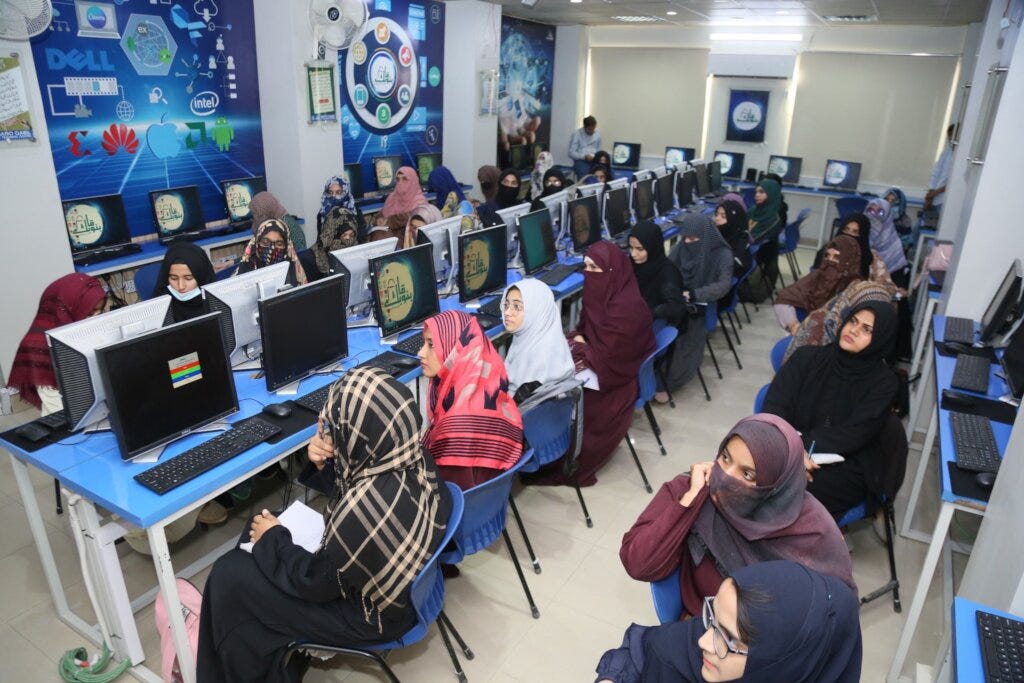
This is where Jugnuu’s work gives students practical exposure before the world punishes them for lacking it. A student does not simply hear what matters; she has to present, make something, open the laptop, build the file, edit the video, design the slide, and solve the problem in front of her.
There is evidence that this kind of model can work in Pakistan. The World Bank reported that the Digital Jobs in Khyber Pakhtunkhwa Project, shaped by digital inclusion work in the province, enabled over 13,000 young people to participate in the digital economy, including 4,284 women and 1,300 persons with disabilities.6 It also helped incubate 25 women-led startups and created more than 1,000 direct and indirect jobs. That proves digital training is not a fantasy for Pakistan’s youth. When training is practical, accessible, and linked to real opportunity, young people respond.
Jugnuu’s mission sits inside this larger national need, but it works at the human level. A country needs millions of jobs. A child needs one first skill. A family needs one daughter or son to gain confidence. A community needs proof that learning can still change a life. This is why small training rooms matter, why a laptop matters, and why a teacher who sits with a student and says, “Try again,” matters.
Traditional education still has value. Children need reading, writing, math, memory, discipline, and moral formation. But the modern child also needs practice. She needs to make things with her hands and mind. She needs to learn how to work with others. She needs to understand technology before technology makes decisions around her. She needs the courage to enter a world that moves fast and still believe she can learn her way into it.
The future will belong to young people who can think clearly, create useful work, communicate with confidence, collaborate with others, and keep learning after the lesson ends. Jugnuu exists because too many children are never given the chance to build those skills early enough.
Every student who learns to make a video, design a poster, write a better message, use AI wisely, or present her own story is doing something larger than completing an assignment. She is stepping into the modern world with proof that she can contribute.
That is what Jugnuu is building.
A generation that does not only hope for opportunity.
A generation that has the skills to meet it.
Jugnuu is building skill, confidence, and opportunity where it matters most. Support the work. Visit a campus. Help more young Pakistanis gain the training that can change a life.
Sahu, Rajesh, Shailendra Vishwakarma, and Ashok Soni. “The Skills Gap: Why Traditional Education Fails to Prepare Students for Modern Workforce Demands.” International Journal of Innovations in Science Engineering and Management 4, no. 2 (May 2025): 223–229. DOI: 10.69968/ijisem.2025v4i2223-229.
World Economic Forum. “Future of Jobs Report 2025: 78 Million New Job Opportunities by 2030 but Urgent Upskilling Needed to Prepare Workforces.” January 8, 2025.
World Economic Forum. The Future of Jobs Report 2025. Geneva: World Economic Forum, 2025.
United Nations Development Programme. “Unleashing the Potential of a Young Pakistan.” Human Development Reports, July 24, 2018.
Shahid, Ariba. “Pakistan Must Create 30 Million Jobs Over Next Decade, World Bank President Says.” Reuters, February 5, 2026.
World Bank. “Connecting Youth to Digital Opportunities: The World Bank’s Collaborative Approaches in Pakistan.” March 5, 2025