

The next economy will punish children who were trained to memorize when the world needed them to think.
That is the central problem behind AI and the future of work. The debate often begins with a dramatic question: will AI replace jobs? The better question is this: which children will be prepared for the work that survives, changes, and grows? A labor market can lose jobs and create jobs at the same time. The winners will be people who can learn new tools, solve practical problems, communicate clearly, and make judgment calls that machines cannot make for them.
The numbers already show the scale of the shift. The World Economic Forum’s Future of Jobs Report 2025 projects 170 million new jobs by 2030, while 92 million roles may be displaced, creating a net increase of 78 million jobs. The same report says employers expect 39 percent of key job skills to change by 2030.1 That means the coming crisis will be a skills crisis before it becomes an employment crisis.
The International Labour Organization reached a similar conclusion from another angle. Its 2025 analysis found that one in four workers globally are in occupations with some exposure to generative AI. Only 3.3 percent of global employment falls into the highest exposure category, but clerical work remains the most exposed, and women face higher exposure than men in the highest-risk category.2 The ILO’s most important finding is blunt: job transformation is the most likely effect because most occupations still contain tasks that require human input.
This distinction matters for Pakistan. A poor student in Mianwali, Lahore, Karachi, or a rural village may hear the phrase “future of work” and think it belongs to someone else. It sounds like a topic for corporate offices, foreign universities, or technology conferences. Yet the shift will enter ordinary life through simple channels: the shopkeeper who uses automated inventory, the school that uses adaptive learning, the clinic that uses digital records, the farmer who checks weather and soil advice, the call center that expects workers to handle AI-assisted customer support, and the small business that wants someone who can use digital tools without constant supervision.
Research on AI and work identifies three major changes: job structures are shifting in manufacturing, services, and knowledge work; skill demand is moving toward technical literacy, data reasoning, algorithmic awareness, emotional intelligence, adaptability, and ethical judgment; and human potential is being redefined through human-AI collaboration, hybrid workplaces, inclusive hiring, and cognitive diversity. A bibliometric review of 1,200 publications from 2020 to 2025 found about 18 percent annual growth in research on AI and the future of work, with five major clusters: automation and displacement, reskilling and upskilling, human-AI collaboration, ethics and algorithmic bias, and policy and governance.3
That research gives Jugnuu a clear direction. AI education should begin with practical skill, then move toward judgment. A child should know how to use a tool, check the answer, explain the process, and understand the consequence. This is the difference between training a user and forming a capable person.
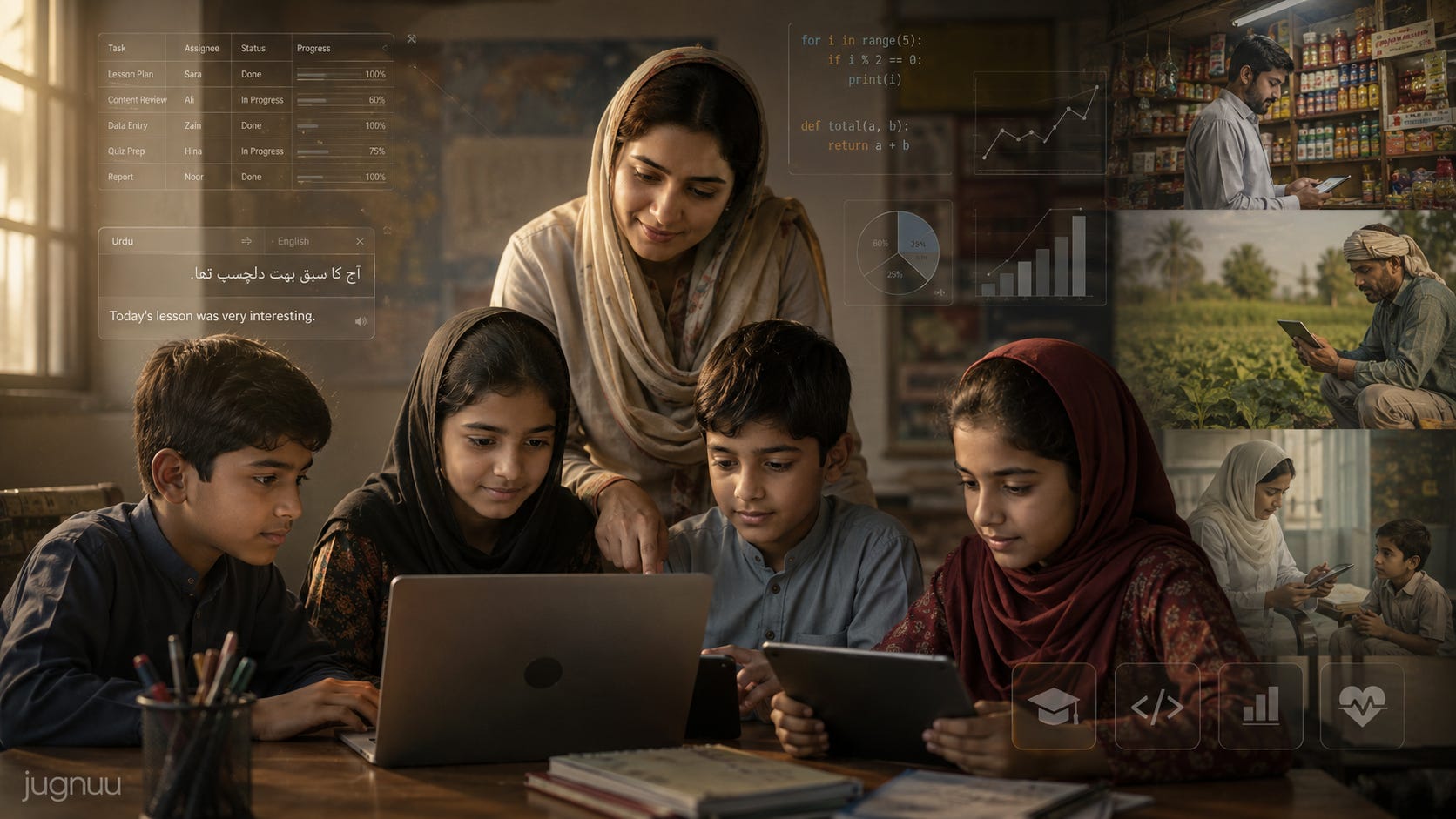
A Jugnuu classroom can make this real. A student can take an English paragraph and translate it into Urdu, then compare the machine translation with a human correction. He learns language, accuracy, and judgment in one task. Another student can build a monthly budget for a household, enter expenses into a spreadsheet, and use AI to explain where money is being wasted. He learns arithmetic, finance, and digital reasoning. A third student can help a local shopkeeper create a simple inventory sheet for rice, flour, lentils, oil, and soap. She learns business logic, organization, and responsibility.
These examples matter because the future of work will reward applied learning. A student who can define “automation” still may be helpless in a workplace. A student who can organize customer orders, summarize sales, write a clear message to a supplier, check a calculation, and explain a decision has real value. The economy pays for usefulness.
This is where many education systems fail poor children. They treat them as if discipline means silence. They teach answers without teaching method. They reward neat notebooks while ignoring problem-solving. They produce students who can pass a test but cannot manage a task. AI will expose that weakness because tools now make weak answers easier to produce. The real advantage will belong to students who can ask better questions.
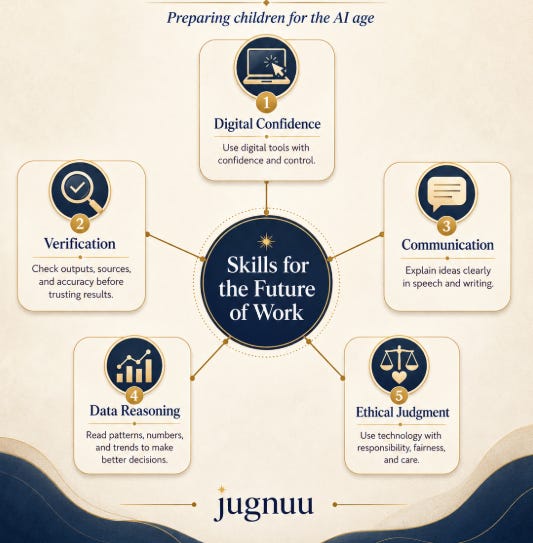
For Jugnuu, the first skill is digital confidence. Many children from low-income communities approach technology as something owned by richer people. That belief damages ambition before the lesson begins. A child must learn that a laptop, phone, spreadsheet, search engine, chatbot, coding tool, and translation tool can be understood. These tools have rules. They make mistakes. They need human direction. Once a student sees that, fear begins to lose power.
The second skill is verification. AI can produce a polished answer that contains an error. That makes verification a survival skill. A Jugnuu student should learn to ask: Where did this answer come from? Does it match another source? Does the number make sense? Could this advice harm someone? In a health lesson, that may mean checking basic medical information against a trusted source. In a scholarship search, it may mean verifying deadlines and eligibility. In a farming example, it may mean comparing weather advice with local conditions before making a decision.
The third skill is communication. The future worker will need to explain what he did, why he did it, and what result it produced. A student who can use AI but cannot explain his work will look dependent. A student who can explain the process becomes employable. This is why English practice, Urdu clarity, presentation, writing, and speaking belong inside AI education. Communication turns hidden effort into visible competence.
The fourth skill is data reasoning. Every modern workplace is becoming a data workplace. A school has attendance data. A clinic has patient records. A shop has sales numbers. A farm has costs, yields, weather, and market prices. A charity has donor records and impact reports. A student does not need to become a data scientist to understand patterns, errors, trends, averages, and decisions. He needs enough data sense to avoid being ruled by numbers he cannot read.
The fifth skill is ethical judgment. Poor communities already know what it means to be judged by systems they did not design. AI can make that problem worse if students learn tools without learning responsibility. A hiring system can reject someone unfairly. A loan app can punish a family through bad data. A school tool can label a weak student as hopeless. A workplace can use monitoring software to control people more tightly. Students need to understand privacy, bias, consent, accuracy, and accountability because technical skill without ethics creates faster harm.
This is why AI education for the Global South requires local design. Much of AI research, funding, and product development remains concentrated in high-income economies. Systems built for wealthy countries often assume stable electricity, fast internet, high English literacy, clean data, expensive devices, and trained users. Research on AI for the Global South warns that this mismatch can deepen inequality unless AI systems are adapted to local realities, local languages, infrastructure limits, and community needs.
Pakistan cannot build its AI future by importing tools and hoping they fit every child. It needs local teachers who understand local families. It needs Urdu and regional-language support. It needs examples from farms, shops, clinics, schools, and small businesses. It needs low-cost devices, offline practice, structured exercises, and clear pathways from classroom skill to earning potential. It needs AI education that works where children actually live.
This is the reason Jugnuu’s neighborhood model matters. A child should not need an elite school to learn the most important tools of the century. A trained teacher in a local home or community classroom can introduce students to AI through everyday problems. The lesson can begin with a family budget, a school timetable, a shop inventory, a crop-cost estimate, a reading exercise, or a job application. The point is direct: take a real problem, use a tool, check the result, explain the decision, and improve the work.
The future of work will also change teachers. A teacher who only delivers information will lose authority because information is already everywhere. A teacher who guides attention, corrects weak thinking, builds discipline, and trains judgment will become more important. AI can generate a worksheet. It cannot notice the quiet student who has stopped trying. It cannot build trust with a child who feels embarrassed by his English. It cannot tell a student, with lived conviction, that his future can become larger than his present.
The strongest Jugnuu teacher will become a coach of capability. She will teach students how to break a problem into steps. She will show them how to compare answers. She will make them rewrite unclear sentences. She will ask them to defend their reasoning. She will make them practice until the tool becomes useful and the student becomes confident. That is education for the AI age.
This kind of education also changes the meaning of human potential. Human potential is often discussed as talent, as if some children are born ready and others are born behind. The AI age makes that view too lazy. Potential grows when a child receives tools, structure, feedback, and a serious expectation. A poor child without exposure may look weak. The same child, given practice and responsibility, may become the person who helps a local business digitize records, helps younger students learn English, helps a farmer compare prices, or helps a teacher prepare better lessons.
The future job market will need people who can work between worlds. It will need workers who understand local problems and digital tools. It will need young people who can speak to a shopkeeper in Urdu, organize data in a spreadsheet, write a professional message in English, use AI to draft options, and explain the final recommendation with confidence. This is the exact space where Jugnuu can prepare students who would otherwise be excluded.
The stakes are high because the old low-skill bargain is breaking. For decades, poor students were told that basic literacy and obedience could lead to stable work. That bargain is weakening. Routine clerical tasks, basic customer service, simple translation, repetitive reporting, and low-level administrative work are becoming easier to automate or partially automate. At the same time, demand is rising for people who can operate tools, manage exceptions, solve customer problems, analyze information, and communicate across teams.
The World Economic Forum lists AI and big data, networks and cybersecurity, and technological literacy among the fastest-rising skills. It also places creative thinking, resilience, flexibility, curiosity, lifelong learning, leadership, analytical thinking, and environmental stewardship among the skills gaining importance. This mix proves the central point: the future worker needs technical fluency and human maturity together.
That is why Jugnuu should resist shallow AI education. Teaching children a few buzzwords will waste their time. Showing them how to generate pretty text will give them weak confidence. The real curriculum should be tougher. Students should learn how to write clear instructions, check outputs, organize information, solve local problems, protect privacy, present findings, and connect their work to income, service, or further education.
A good Jugnuu AI project should end with something visible. A student produces a cleaned spreadsheet, a corrected translation, a simple website, a budget plan, a lesson summary, a scholarship tracker, a crop-cost comparison, a shop inventory system, or a spoken presentation. The output matters because it proves the student can make something useful. Confidence grows faster when the child can point to completed work.
This approach also protects dignity. Many poor children are treated as future labor before they are treated as minds. AI education can repeat that mistake if it only trains them for low-level digital tasks. Jugnuu should aim higher. The goal is to produce students who can question, build, verify, explain, and lead. They should become capable of earning, but also capable of refusing bad information, unfair systems, and low expectations.
The UNDP’s 2025 Human Development Report frames AI as a matter of human choice. Its central argument is that development depends less on what AI can do and more on the choices societies make so people can live lives they value. That is the right frame for Jugnuu. AI becomes useful when it expands a child’s choices. It becomes dangerous when it narrows those choices or places power farther away from the people who need it most.
The future of work will be decided in policy rooms, boardrooms, universities, and laboratories. It will also be decided in small classrooms where one teacher shows one child how to think with a tool instead of being intimidated by it. That second place may matter more than we admit.
Jugnuu’s task is clear. Give children access, structure, language, digital confidence., ethical judgment. Give them real projects. Give them the experience of completing useful work before the world tells them they are unprepared.
The future will not ask children whether they are ready.
It will ask whether they can use a tool, check an answer, explain a decision, and solve a real problem. That is why Jugnuu’s work matters now. We are not preparing children for a distant age. We are preparing them for the first job interview, the first online application, the first digital task, and the first moment when someone expects them to prove they belong.
Your donation can help students across Pakistan gain skills, confidence, and a path toward real opportunity. This Eid, sacrifice can reach beyond one meal, one day, or one household. It can become a classroom.
Jugnuu now has a new home for Urdu readers. This space will be for stories, updates, lessons, and reflections written in a voice that feels closer to home for many of the Jugnuu students and teachers.

If you would like to receive new posts from Jugnuu Urdu directly in your inbox, please change your settings here and turn on notifications for Jugnuu Urdu | جگنو اردو:
Some stories reach the heart more clearly in the language we carry inside us.
Jugnuu is building skill, confidence, and opportunity where it matters most. Support the work. Visit a campus. Help more young Pakistanis gain the training that can change a life.
World Economic Forum. (2025). The Future of Jobs Report 2025. World Economic Forum.
Gmyrek, P., Berg, J., Kamiński, K., Konopczyński, F., Ładna, A., Nafradi, B., Rosłaniec, K., & Troszyński, M. (2025). Generative AI and jobs: A refined global index of occupational exposure (ILO Working Paper No. 140). International Labour Office.
Singh, S. (2025). AI and the future of work: Redefining skills, jobs, and human potential. In N. Kumar, I. B. Lal, & M. Kumar (Eds.), Next-Gen Machine Learning: Algorithms for Adaptive Intelligence (pp. 39–51). Book Rivers.