

The world’s wealthiest families are betting that memorization alone will fail their children in an AI-driven economy. They are paying up to $75,000 a year for schools built around adaptability, communication, negotiation, entrepreneurship, and personalized AI-assisted learning. jugnuu exists because these skills should never remain the privilege of the few. In neighborhood learning nodes across Nowshehra, Karachi, and Mianwali, students from low-income communities are already developing the same future-facing abilities at a fraction of the cost. The demand is global. The access gap is our mission.
A recent Wall Street Journal article by Katherine Bindley1 captures how quickly the education landscape is shifting among high-income American families. These parents are looking beyond traditional schools because they believe the old model no longer matches the world their children will inherit. Ankur Jain, president of a hedge fund, moved his 11-year-old son, who was happy and excelling academically, toward Forge Prep in New Jersey. The school emphasizes real-world problem-solving, business-building, product design, sales, public speaking, and negotiation. Jain wanted his son to develop tools he himself did not fully gain until his 20s. His question cuts to the heart of the change:
“If we’re still teaching kids the way we did 60, 70, or 80 years ago, how are we preparing them?”
That question should echo in every Pakistani home, classroom, and policy discussion. AI is changing what information is worth. A child trained only to memorize facts will compete against machines that summarize, translate, calculate, code, and generate routine work in seconds. The lasting advantage will belong to students who ask sharper questions, solve unfamiliar problems, communicate clearly, use tools wisely, collaborate across differences, and adapt when conditions change.
This explains the intense interest in schools like Alpha and Forge Prep. Alpha offers two hours of AI-based tutoring followed by project-based workshops. Its platform tracks performance and attention, then adjusts the curriculum around how each student learns. One San Francisco parent plans to enroll his son in Alpha’s kindergarten despite the $75,000 annual tuition because he sees personalization as the main value. The promise is a learning loop where the child’s progress shapes the next lesson.
Forge Prep follows a different path from the same starting point. Its founder, Anand Sanwal, received 600 applications for just 34 seats. The school plans to expand through 12th grade and eventually serve 400 students, with tuition moving toward $60,000. A graduate who launches a company and works on it full-time may even qualify for a $200,000 investment from the school. Forge also keeps phones out, limits Chromebook use, and focuses AI on creation rather than passive consumption.
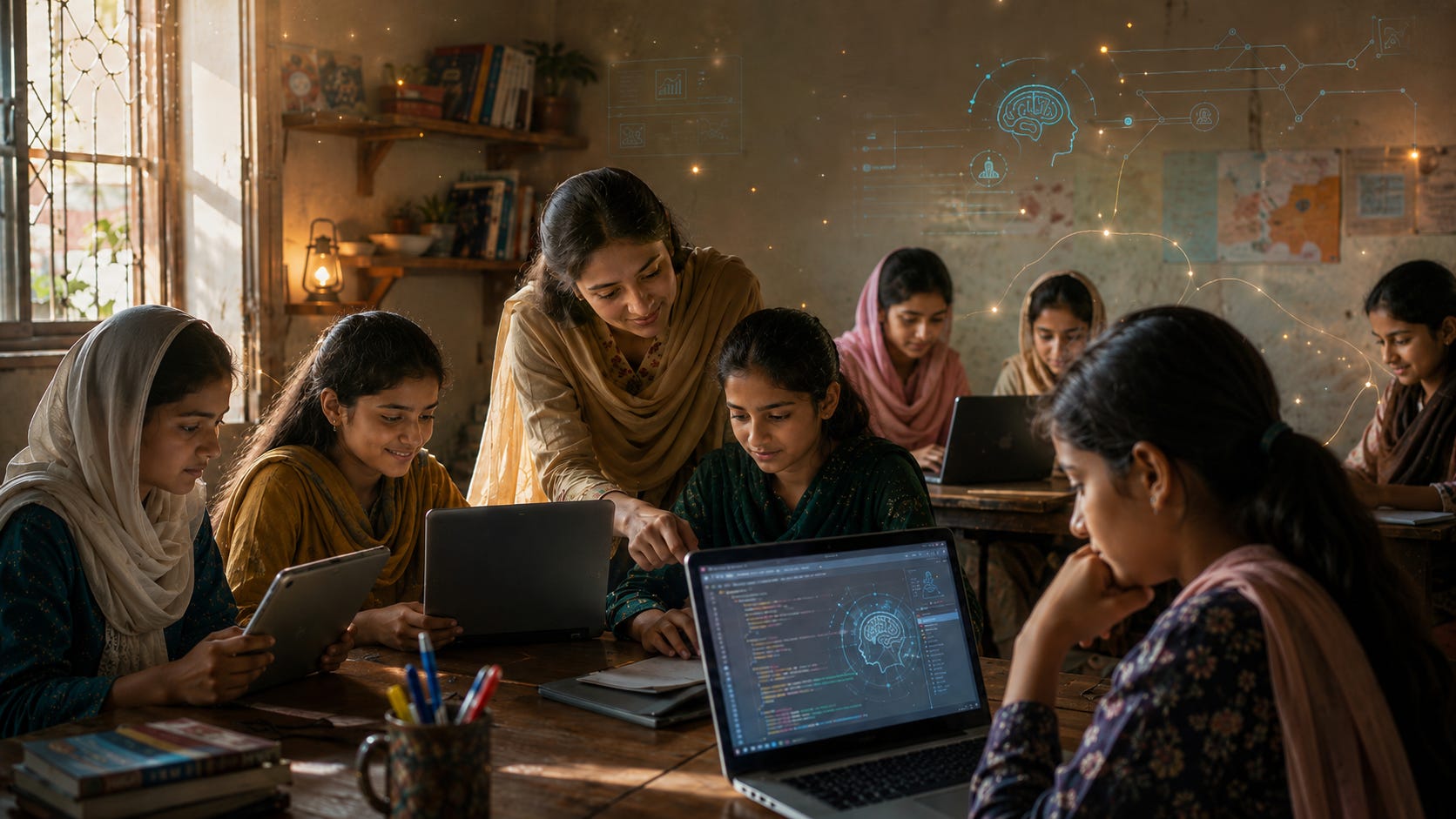
That distinction matters deeply for jugnuu. AI should become a tool for understanding concepts, refining presentations, building simple websites, drafting business plans, practicing English, designing visuals, and preparing for real opportunities. Copying an answer teaches little. Using AI to create, revise, test, and solve builds a stronger mind.
This is where jugnuu is already aligned with the future. Our students are learning in community spaces, local rooms, and neighborhood classrooms rather than elite campuses with polished facilities and powerful networks. They are gaining digital confidence, exploring coding, practicing communication, and solving practical problems. They are discovering that education can prepare them for life, work, and responsibility, not only exams.
The contrast is striking. The richest families are investing extraordinary sums in the same categories of skills jugnuu is delivering to underserved communities. The setting is different. The price is different. The direction is the same. Education is moving toward adaptability, creativity, intelligent technology use, clear communication, and entrepreneurial thinking.
For decades, underprivileged children were told to catch up to a system that already failed too many of them. Now that system itself is changing. The old ladder is being rebuilt while millions remain at the bottom. jugnuu’s work ensures boys and girls from low-income families step onto the new ladder early, before AI turns today’s access gap into tomorrow’s permanent divide.
The Wall Street Journal piece also raises important cautions, and jugnuu should take them seriously. Stanford economist Caroline Hoxby notes that evidence remains limited on whether these new models outperform traditional schools. Other experts warn that redefining teachers as “guides” or “coaches” can weaken respect for the teaching profession. There is also concern that elite entrepreneurial schools may produce narrow student bubbles where wealthy children learn future-facing skills mainly alongside other wealthy children.
These critiques sharpen jugnuu’s case. Where elite experiments lack public proof, we can build evidence from day one by tracking attendance, skill portfolios, AI proficiency, communication growth, parent feedback, freelance earnings, and job placements. Real results must carry the mission.
Where some models risk weakening the teacher’s role, jugnuu can strengthen it. AI can deliver content, translate material, generate practice, and personalize exercises, but a caring teacher provides judgment, encouragement, correction, structure, and belief in a child’s potential. In communities where many children have rarely been told they can build a future, teachers make that future feel possible.
Where elite schools risk insularity, jugnuu becomes the bridge. Children of privilege often inherit networks, safety nets, and second chances. A child in a low-income Pakistani neighborhood may bring intelligence, discipline, and hunger, yet still lack consistent access to devices, mentorship, and exposure. jugnuu closes that gap with a model rooted in the community itself.
This is why jugnuu did not wait for elite schools to declare that education needed to change. We already understood that memorization alone cannot transform lives. We chose the neighborhood node, the local teacher, the practical curriculum, the laptop, and the community model because those are the tools that can turn access into opportunity.
The future of education will belong to approaches that blend human care with modern tools. It will belong to programs that teach children how to think, speak, build, adapt, and earn with integrity. jugnuu is positioned for that future because its model is simple, local, affordable, and scalable.
One room can become a classroom. One teacher can become a mentor. One laptop can open a door. One student can become the first in a family to thrive in the digital economy.
The wealthiest families in America are showing what the future demands. jugnuu’s answer is clear: those skills should become tools of dignity, opportunity, and mobility for every child ready to learn.
The education revolution has begun. jugnuu’s mission is to make sure Pakistan’s children do more than catch up to it. They help build it.

Bindley, Katherine. “High-Earner Families Are Ditching Traditional Schools for Life Skills and AI.” The Wall Street Journal.