

Poverty begins to break when a child learns how to create value. More than 600 years ago, Ibn Khaldun studied why civilizations rise, endure, and decay. Born in Tunis in 1332, he wrote the Muqaddimah, one of the most important works ever written on society, history, economics, and power. His insight was simple but profound: wealth begins when human beings cooperate, specialize, build trust, learn useful skills, and live under leadership that protects work instead of crushing it.
That understanding carries a direct lesson for jugnuu.
A small learning node with 10 to 25 students, a trained teacher, laptops, internet, AI lessons, communication practice, and VIBE coding may look modest from the outside. In Ibn Khaldun’s terms, it is the beginning of economic transformation. It takes scattered talent and gives it structure. It turns a room into a place where students learn how to produce, explain, design, build, and solve.
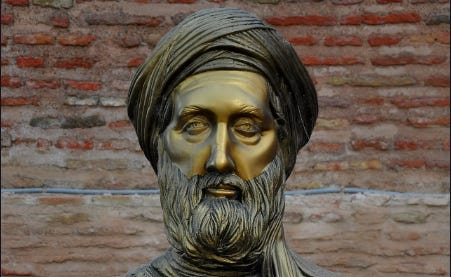
His central idea was asabiyyah, often translated as social cohesion or group solidarity. Ibn Khaldun saw social cohesion as a decisive force behind the rise of civilization. Committed leaders and motivated people working together mattered more than capital, natural resources, or unskilled labor alone. Cooperation formed the basis of social organization, and it became more important as societies developed.
That is what a jugnuu node must build. The founder provides the mission. The teacher creates discipline. The students bring effort. Parents lend trust. Donors provide tools. The community protects the space. Without that bond, a laptop remains a device. With that bond, a laptop becomes a bridge to work, confidence, and opportunity.
Ibn Khaldun also understood specialization centuries before Adam Smith. In the Muqaddimah, he argued that one person alone cannot secure the necessities of life. But when several people cooperate - one making tools, another ploughing soil, another harvesting grain, and others managing different tasks - their combined labor produces far more than their own needs. Ibn Khaldun made this division-of-labor argument roughly 400 years before The Wealth of Nations.
That gives jugnuu students a practical lesson. One student may become strong in AI prompts. Another may become strong in design. Another may speak well. Another may understand websites. Another may organize a project. A classroom becomes powerful when students stop seeing learning as isolated marks and begin seeing skill as shared production. The question after every month should be concrete: what can this student now build, explain, write, design, or improve?
Ibn Khaldun’s sharpest economic line was this:
“Profit is the value realized from human labor.”
That sentence belongs at the heart of jugnuu. Wealth begins when effort becomes skill. A child who learns AI is learning how to ask better questions. A child who learns communication is learning how to be heard. A child who learns coding is learning how to shape tools rather than only consume them. A child who learns financial literacy is learning how money moves through a household, a shop, a market, and a life. Weiss notes that Ibn Khaldun saw education, science, and technical capacity as forces that increase productivity, and that technical capacity attracts more talent once it begins to exist.
This is why jugnuu teachers matter so much. They are multipliers of productive power. A good teacher does more than explain a lesson. She turns attention into discipline and fear into confidence. She helps a student move from “I do not know this” to “I can try this.” That shift matters because many children from low-income communities have been trained by circumstance to expect less from themselves. A serious teacher interrupts that expectation.
Ibn Khaldun’s own life proves the role of formation. His educational phase lasted 18 years in Tunis, where he studied religious principles, language, logic, philosophy, literature, and law under his father and several teachers. His mind was shaped by talent, but also by years of guided study, serious instruction, and disciplined exposure to different fields.
For jugnuu founders, Ibn Khaldun offers a warning as well as encouragement. He argued that rulers damage society when they overburden the people who produce value. Heavy taxation, monopolies, price manipulation, and rulers entering trade all weaken incentive. His famous tax insight remains clear: early dynasties collect large revenue from small assessments, while late dynasties collect small revenue from large assessments. When people believe effort will be punished or captured, they produce less.
For jugnuu, that means protecting the productive base: the teacher, the student, the classroom, and the trust of the community. Keep the model simple. Measure what matters. Track attendance, skill growth, completed projects, teacher quality, student confidence, parent trust, and local outcomes. Paperwork should serve learning. Slogans should never replace visible student progress.
The goal is to help children become useful, skilled, confident, and capable of creating value. One student can help a parent write a message, design a flyer, build a simple page, explain an online form, improve a small shop’s presence, teach a sibling, or speak clearly in an interview. That is productive dignity.
Ibn Khaldun saw economics as civilization in motion. Work creates value. Trust makes cooperation possible. Skill increases productivity. Education strengthens the human being. Leadership protects the conditions in which people can build.
A jugnuu classroom may begin with four walls, a teacher, laptops, and children who have been given too few chances.
It becomes something greater when a child walks out able to build, speak, solve, and believe that their work can change the terms of their life.
Jugnuu is building skill, confidence, and opportunity where it matters most. Support the work. Visit a campus. Help more young Pakistanis gain the training that can change a life.