

A few months ago, I read the story of a young man in Bangladesh who joined the protests that helped topple his country’s government. He wasn’t chasing fame or ideology. He wasn’t trying to become a revolutionary icon. He was simply a graduate who believed the promise his society had repeated his whole life: study hard, get your degree, and you’ll earn stability. But after the protests succeeded and the headlines moved on, nothing changed for him. He was still unemployed. Still applying. Still rejected. And when a reporter asked what mattered most, he didn’t talk about politics. He said something far more honest: “A job is the first priority for me. If I have money, I can dream of many things. But if I have no money, how do we eat?”
That sentence carries the quiet panic of an entire generation. Not only in Bangladesh, but across much of the world. Because the modern economy is beginning to reveal an uncomfortable truth: education is no longer the guarantee it once was.
For decades, a college degree was treated like a shield. It wasn’t just knowledge. It was protection. It was the one path parents trusted, the one path young people believed would separate them from struggle. Entire families sacrificed to send children to university because they saw it as the clearest route to security and respect. In many cultures, a degree became almost sacred. But the world that made that bargain possible is changing fast, and the numbers now show that the old promise is weakening.
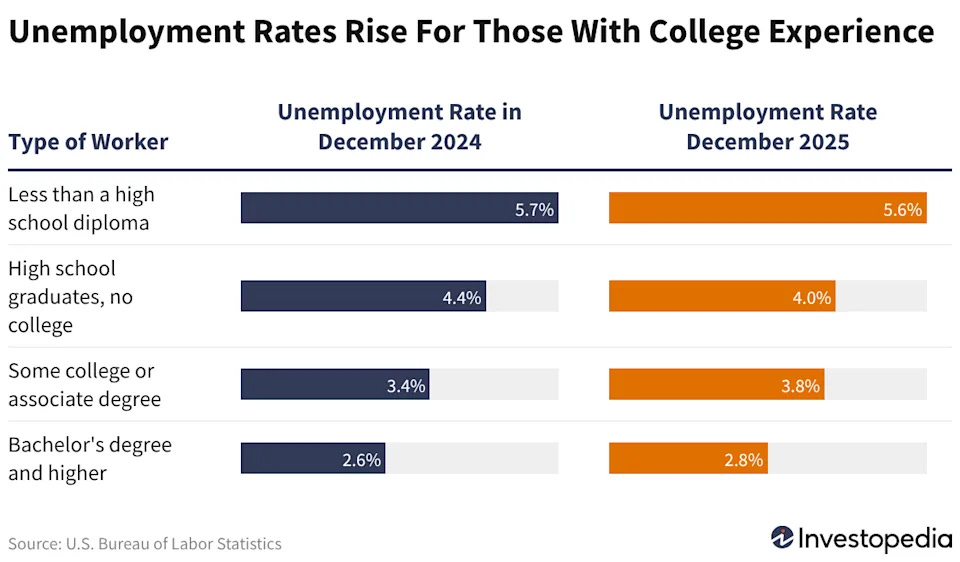
In the United States, a Goldman Sachs analysis highlighted a trend that should make every parent pause. In 2025, unemployment rose for workers with college experience while it fell for workers with no college experience. Workers with a bachelor’s degree or higher saw unemployment rise to 2.8%, up from 2.6% the year before. The figure is still below the national unemployment rate, but the direction matters more than the level. It signals something deeper: the advantage of being credentialed is shrinking, especially for the young.
What makes this shift even more striking is that it isn’t primarily being driven by AI, despite how often people blame technology for everything. Goldman’s analysis suggests the bigger issue is simpler and more unsettling: hiring has frozen. From 2023 to 2025, the industries that employ the largest share of college graduates, information services, finance, and professional and business services, shed an average of 9,000 jobs per month. Before the pandemic, those same industries were adding roughly 44,000 jobs per month. That reversal matters because it reveals a new reality. The sectors that once absorbed educated workers are no longer expanding the way they used to, and entry-level positions are being squeezed hardest.

Meanwhile, industries that hire fewer college graduates have continued to grow. Construction, transportation, and retail trade added about 12,000 jobs per month over the same period. This is the part that breaks the old story people were raised on. The “educated economy” is not automatically expanding. The hands-on economy, the world of logistics, building, maintenance, and operations, is still moving because it is tied directly to physical needs that cannot be postponed forever.
The consequences show up most sharply in the lives of young graduates. In December, college graduates ages 22 to 27 faced an unemployment rate of 5.6%, only 2.2 percentage points below the 7.8% unemployment rate for young workers without a bachelor’s degree. Historically, that gap was much wider. Even more unusually, recent graduates now have higher unemployment than the overall workforce, a reversal of the pattern that defined the last few generations. The people who were told they were “future-proof” are starting to feel replaceable.
Bangladesh shows what happens when this mismatch becomes extreme. The country has expanded its university system rapidly, producing at least 700,000 graduates every year. But many leave university without practical skills that match what employers need. The result is brutal. One-third of Bangladesh’s unemployed population, roughly 900,000 people, are university graduates. The unemployment rate for college graduates has surged to nearly 14% in 2024, up from 5% in 2010. Meanwhile, those with no formal education have an unemployment rate around 1.3%. These numbers describe a society where education has become disconnected from employment, and where young people who believed they were building a future instead find themselves trapped in disappointment.
Employers in Bangladesh have started saying the quiet part out loud. One garment manufacturer explained that he rarely hires university graduates because their education doesn’t match the work. He said bluntly that he doesn’t need more graduates in subjects that don’t translate into jobs. He prefers vocational workers who want to work on the floor. That statement may sound harsh, but it reflects a reality that is now spreading globally: employers do not hire people for their dreams. They hire people for their usefulness.
This is why skills matter more today than ever before. A degree signals that you completed a system. A skill proves you can create value in the real world. When the labor market is strong, companies can afford to hire based on potential and train people over time. When the labor market freezes, that generosity disappears. Employers become cautious. Training budgets shrink. Risk tolerance collapses. And the hiring question changes from “Who seems impressive?” to “Who can contribute immediately?”
Automation sharpens this reality even further. Bangladesh’s garment sector has already shed jobs, with employment falling from 4.1 million in 2019 to 3.7 million recently. Factory owners have installed machines that reduce labor needs, and some have adopted AI-powered design software that allows two designers to do work that previously required a dozen. This is not science fiction. It is happening now, and it is happening fastest in industries where millions of livelihoods depend on a narrow set of jobs.
This is not an argument against education. Education matters deeply. But education without practical skill has become fragile. It leaves people exposed when industries slow down. It creates a false sense of security. It produces young people who are intelligent, ambitious, and hardworking, but still unemployable because they cannot translate knowledge into output. And when enough young people become unemployable, the problem stops being personal. It becomes social and political. Unemployment doesn’t just reduce income. It destroys confidence, delays marriage, fuels resentment, pushes people toward migration, and creates the kind of despair that makes societies unstable.
This is exactly why Jugnuu exists. Jugnuu is built on the belief that young people deserve more than motivation and diplomas. They deserve tools. They deserve training that makes them capable, employable, and independent. A skill is not just a career advantage. It is a form of dignity. It gives a person leverage in an uncertain world. It gives them the ability to stand on their own feet when the economy tightens, when industries shift, and when old promises collapse.
If you believe in this mission, I invite you to become a rope-holder for Jugnuu. Help us equip young people with skills that can carry them through instability, protect them from dependency, and give them the chance to build a life with dignity. The next decade will not reward those with the best credentials. It will reward those who can actually do something real.
If Jugnuu’s mission speaks to you, consider becoming a rope-holder. Your support helps us train young people with real skills, real capability, and real independence, so they aren’t left behind in a world that is changing faster than most people realize.
Very thoughtful ideas. Ai is becoming a new industry. And because of it, many experts will have to an unlearn what they know and relearn things based on AI. Young people have advantage because they don’t have to unlearn anything, they just have to learn the right AI skills.
Thank you for the work being shared here